Legacy Application Modernization for Telecom BPO

Modernizing over 150 legacy applications in just 12 months using the Jaggle low-code platform

  • Client Name:

    Cosmote

  • Sector:

    Telco

quote

The introduction of Jaggle into our environment enabled the modernization of key internal systems with minimal disruption. The platform’s ability to integrate with our legacy architecture while supporting fast-track development proved critical.

Efi Alerta

Head of Business Technology Solutions Cosmote eValue

150+

legacy applications modernized

40%

reduction in total cost of ownership (TCO)

10×

faster development cycles

Overview and Objectives

Issues:

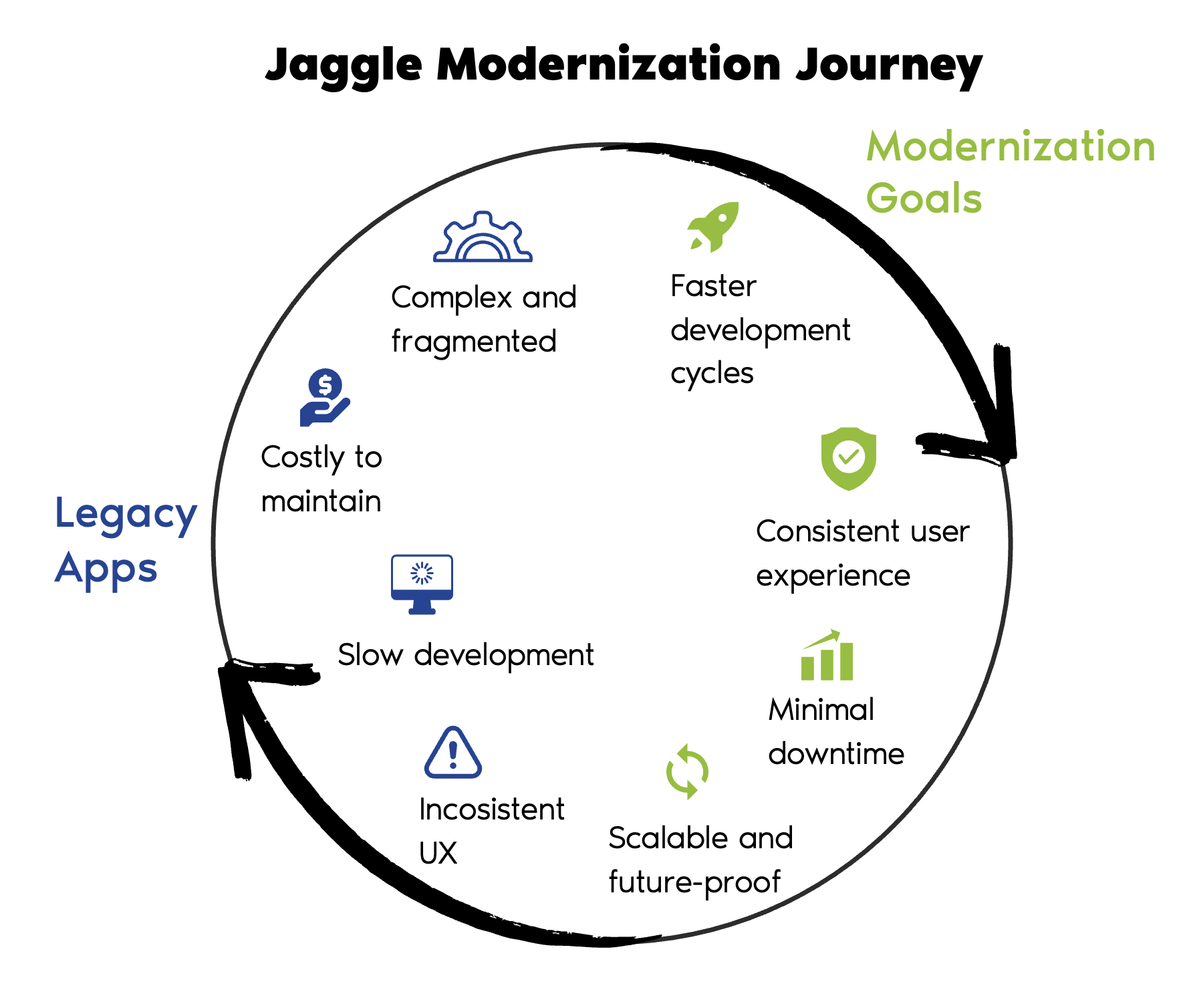
  • Cosmote e-Value was operating 150+ legacy applications built on outdated technologies.
  • These systems were costly to maintain, difficult to upgrade, and delivered an inconsistent user experience.
  • Adding new features or modifying processes took months due to rigid, code-heavy environments.
  • There was a risk of disrupting critical operations during modernization efforts.

Goals:

  • Modernize the entire legacy application portfolio swiftly and securely.
  • Reduce maintenance costs and consolidate operations onto a unified platform.
  • Deliver a consistent, modern user interface across all applications.
  • Enable faster development cycles and allow business users to contribute directly to process updates.
  • Ensure scalability, cloud-readiness, and minimal downtime during transition.
  • Future-proof the system to support emerging technologies like chatbots and advanced analytics.

Problem and Solution

Problem

Cosmote e-Value was burdened by over 150 outdated legacy applications, leading to high maintenance costs, slow feature delivery, and an inconsistent user experience. These systems were difficult to modify and posed a risk of disruption if replaced all at once—creating a major challenge for modernization at scale

Solution

Jaggle low-code platform was used to rapidly rebuild and replace legacy apps through a centralized, modular approach. With visual development, reusable components, and real-time integration with legacy systems, the team modernized over 150 apps in just 12 months—reducing costs by 40%, improving performance, and enabling agile feature updates with minimal downtime.
Results & Metrics

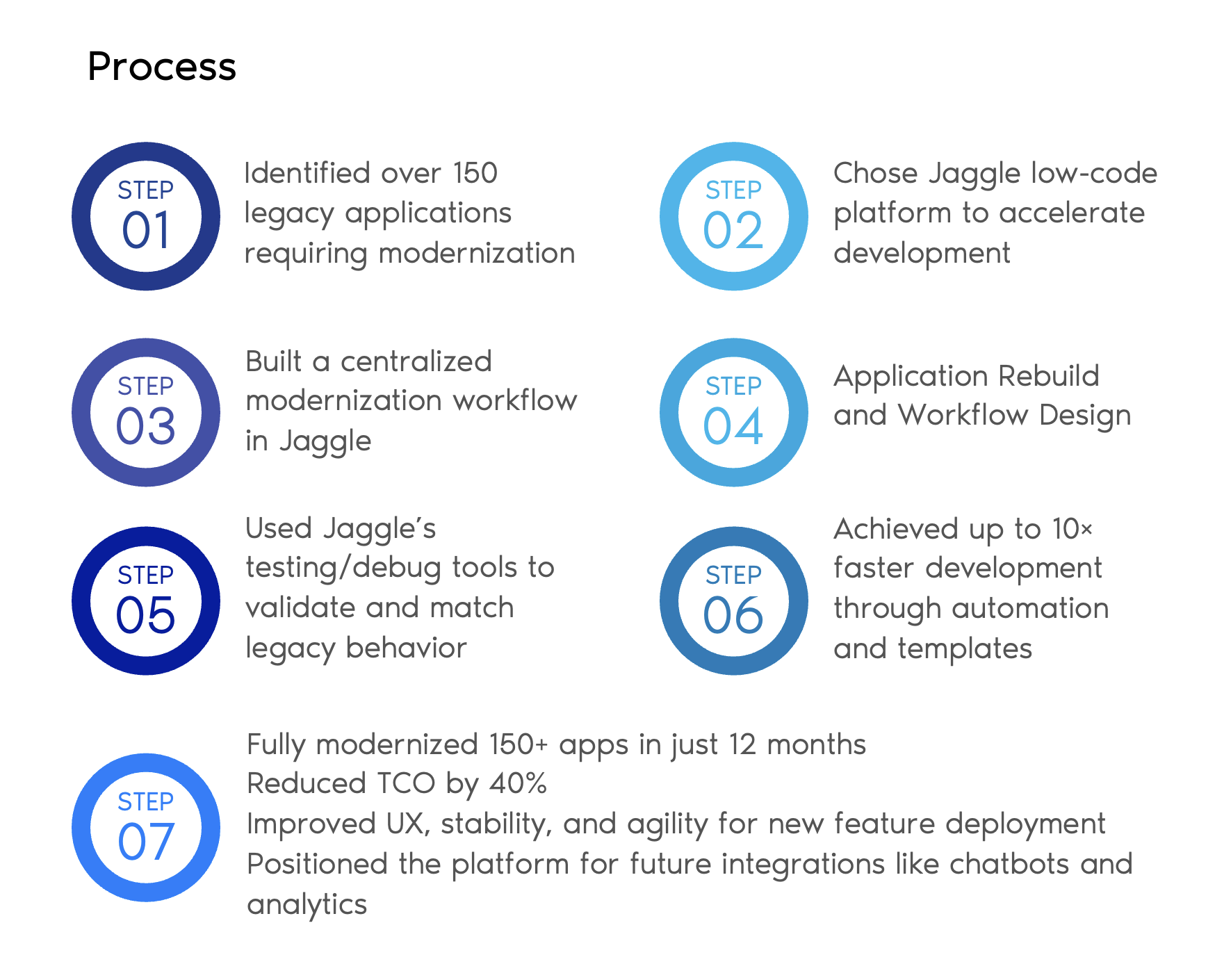
  • 150+ legacy applications modernized in just 12 months (vs. years with traditional methods)
  • Up to 10× faster development cycles using low-code, visual tools, and reusable templates
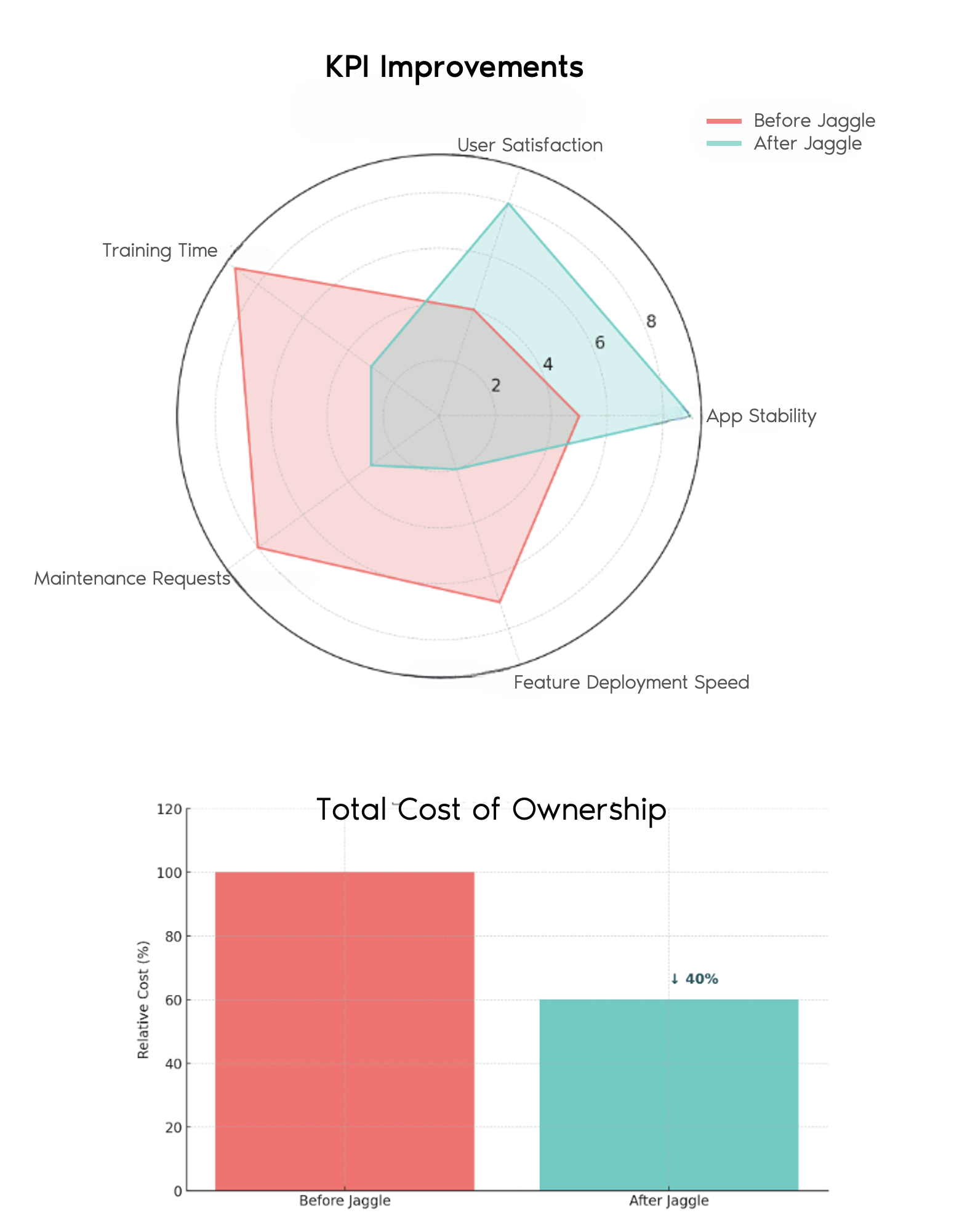
  • 40% reduction in total cost of ownership (TCO) through system consolidation
  • Modern, consistent user interface (UI) improved usability and reduced training time
  • Incremental rollout ensured smooth transition with minimal downtime or risk
  • Business analysts empowered to make logic updates without developer input
  • Improved app performance and system stability on a modern architecture
  • Cloud-ready and future-proof, enabling easy integration of chatbots, analytics, and other technologies
  • Multiple teams collaborated in parallel, accelerating delivery through Jaggle Studio
  • Legacy logic made transparent and adjustable, simplifying ongoing maintenance

Conclusion

  • 150+ legacy applications modernized in just 12 months, significantly faster than traditional approaches
  • 10× faster development cycles enabled by Jaggle’s low-code platform and reusable components
  • 40% reduction in total cost of ownership (TCO) through consolidation and automation
  • Unified, user-friendly interface reduced user errors and training time
  • Parallel rollout of old and new systems minimized business disruption during transition
  • Empowered non-developers (e.g., business analysts) to update logic and workflows visually
  • Cloud deployment and scalable architecture supported future growth and rapid rollout
  • Seamless integration with legacy systems ensured data continuity and operational stability
  • Future-ready foundation enabled easy addition of AI, chatbots, and analytics capabilities
  • Improved agility: feature updates now take days or weeks instead of months