


January 20, 2026
Jaggle Insights: Beyond the Go-Live | Why the Public Sector must consider low-code to enhance digital transformation capabilities
Executive President, Comsys
The conversation around public sector digital transformation often begins, and too often ends, with the announcement about the general availability of a digital service. We celebrate the launch, a press release follows, and the “go-live” is treated as the finish line.
For Information Officers and IT Directors who are responsible for these services, go-live is not the end. It is the beginning of the most demanding phase of the service lifecycle: reliability, security, compliance, and responsiveness. Implementing necessary changes requires continuous effort.
The real challenges start right after launching. When legislation is amended, Internal operational processes change. When data protection obligations such as the General Data Protection Regulation, and cybersecurity obligations under frameworks such as the Network and Information Security Directive (NIS2) require large-scale code refactoring. When a new registry is introduced and must exchange data with existing registries, repositories, platforms, and legacy systems, which are often built on different multi-vendor technologies, at different times, by various teams.
Digital public services are not static assets; they are living systems. And in a sector where accountability and long-term continuity matter, the real question is not “When will it be implemented?” but “How will it remain reliable, secure, and adaptable for the next, possibly, ten years?”
The “digital project” trap
There is a fundamental misunderstanding in how organizations evaluate progress in government information technology. We measure success by the number of projects delivered. Yet the pressure on public administration rarely comes from a single mega-project.
It comes from the accumulation of hundreds of small-to-medium changes required continuously:
● Adjustments to the operational, regulatory, and institutional framework
● New requirements from citizens and the government
● The daily reality of heterogeneous systems with a high degree of “embedded legacy” that must cooperate without problems
When every change is treated as a new standalone “project,” an organization eventually hits a wall. The queue of change requests grows faster than the capacity to implement. Even capable teams struggle to keep pace with the increasing demand for development of new applications, not because they lack talent or commitment, but because their application-layer software infrastructure is not designed to support continuous improvement and change.
The outcome is predictable. Maintenance consumes time that should be dedicated to improvement. Change becomes difficult, expensive, and risky. Teams become conservative, not by choice but by necessity. The organisation stops evolving, while demands are increasing.
From one-off delivery to continuous digital capability
Breaking this cycle requires a shift in mindset: from delivering digital projects to building a modern digital capability as the central application delivery to support application development and lifecycle management horizontally.
Digital capability is not a slogan. It is a practical operating model: the ability to deliver, update, and improve applications consistently with control.
This is where the low-code application development methodology plays a meaningful role when approached correctly. Low-code should not be viewed merely as a shortcut to “speed,” even though faster delivery is a substantial benefit. For the public sector, low-code becomes valuable when it is treated as a standardised framework for application development and lifecycle management, reducing variation in the underlying technology fabric, improving maintainability, bridging incompatibilities across technologies, design approaches, and software development practices, and supporting disciplined change management.
AI-powered capabilities further strengthen the low-code approach: AI accelerates application design, development, maintenance, and updates, supports consistent documentation, and enables assisted quality assurance processes that reduce errors. Especially when change is frequent, and the margin for risk is small.
Three principles for sustainable public sector application lifecycle management
When low-code is adopted as a governed approach, rather than a tactical tool, it can unlock repeatable advantages across an entire portfolio of public services. The focus is not on one application. It is the mechanism that produces many applications over time.
A. Speed with control: governance as an enabler
In the public sector, speed cannot come at the expense of accuracy, legality, and security. These are not negotiable.
When processes and their supporting logic change frequently, standardization becomes the safety net. A well-governed, low-code environment enables change management by reducing the “variation factor”. The objective is not to move quickly by cutting corners, but to move confidently through discipline: standardized components, built-in guardrails, and precise role-based controls for safe and repeatable change management.
Low-code platforms reduce change implementation time and the likelihood of introducing errors that are difficult to detect and costly to correct later.
B. Reducing technical debt through standardization and AI-powered capabilities
Technical debt is the silent constraint on public-sector digital transformation projects. It accumulates every time a solution is implemented without adequate design, documentation, code development, and testing, often under legitimate pressure to meet deadlines.
Over time, organizations become dependent on individuals who “remember how it works.” When knowledge is not embedded in the system, continuity becomes fragile, especially over the years, internal personnel transitions, and vendor changes.
A mature low-code approach helps reduce the structural causes of technical debt through industry-standard mechanisms. It supports consistent patterns for workflows and data structures, automates documentation, and reduces fragmentation introduced by ad hoc technology choices. The result is simpler maintenance and safer evolution over time.
AI-powered capabilities reinforce this discipline by accelerating routine engineering work, such as producing initial drafts of models, workflows, user interfaces, and documentation, and by automating code and system testing. consistency. The engineering discipline remains essential, and low-code makes it easier to apply consistently, so the ‘right way’ becomes the default.
C. Interoperability as a permanent condition. Interoperability is too often treated as a one-time bridge built for a specific river. But in a modern state, systems must exchange data constantly with tax authorities, social security systems, banks, and other European software platforms. The challenge is that many of these systems were built using different technologies and architectural assumptions, which makes coordination and change harder over time.
Interoperability is not a project milestone. It is a permanent operational condition.
A governed low-code platform supports this by enabling reusable integration interfaces. Instead of creating a new integration from scratch each time, organizations can use secure, reusable integration components developed centrally.
The shift is significant: from one-off integrations to repeatable integration capability.
Built for high-accountability environments
Public sector teams operate in an environment where resources are finite.. The people responsible for application management are accountable for processes, legality, continuity, and trust. They do not need more complexity. They need tools and frameworks that amplify effectiveness while preserving control.
A realistic approach to modernization does not begin with rewriting everything. It starts by selecting high-impact applications where the benefits of standardization are visible quickly, and where organizations learn how to operate the new model.
Examples include:
● High-change services: applications where rules and workflows change frequently (for example, benefits, licensing, and eligibility processes).
● Integration-heavy applications: cases where multiple systems must exchange data, and manual reconciliation slows down decision-making and service delivery.
● Operational efficiency hindering points: internal tools that reduce back-office workload and streamline frontline administrative processes, freeing public servants to focus on service quality.
The mechanism matters more than the milestone
The public sector has shown it can achieve rapid results when there is a clear goal and collective focus. The next step is more demanding but far more valuable: establishing a mechanism for continuous application production and evolution of public services.
Quality is not an attribute that must be present in the first version of a digital service. It is essential to see how quickly, reliably, and securely the service can improve in the future. Without losing control, without multiplying complexity, and without creating unwanted risks.
This is the lens through which we approach low-code at Jaggle.eu: not as a promise to “deliver applications faster,” but as a platform to impose discipline to build quality software and sustain digital capability in high-accountability environments. With AI-powered capabilities embedded in the platform, the goal becomes even more practical: accelerating changes and updates, improving quality through automated assisted testing and consistency checks, and reducing the friction that slows public services after go-live.
About the Author

Vassilis Galakos is an experienced information technology executive with more than 35 years of leadership and hands-on involvement in enterprise ICT initiatives across telecom, banking, utilities, and the public sector.
Vassilis holds a graduate degree in Applied Biomechanics from Indiana University and has strong background in the design, delivery, and evolution of complex technology projects with responsibilities spanning strategic planning, technology direction, and executive oversight.
He is the Founder and Executive President of Comsys.

December 22, 2025
Jaggle Insights: What Banking and Insurance Leaders Really Tell Me About Their Application Backlogs
by Dimitris Kostoulas
Sales & Business Development Manager, Comsys
In my role, I connect with a broad spectrum of organizations – banks, insurers and financial institutions. The logos change, the company sizes change, but the conversations are surprisingly similar.
Nobody asks me to “do digital transformation”. They ask very specific, very pragmatic questions:
“How do we stop running core processes on Excel and email?”
“How do we respond to the regulator without breaking our legacy systems or overloading our teams?”
“How do we roll out a new product before the competition does and internal systems are ready to support it??”
“How do we make all of this secure and compliant when our data and processes are so fragmented?”
In those conversations, Jaggle is not a buzzword. It is a way to remove very real blockers from very real projects.
Jaggle is our enterprise-grade, AI-powered Low-code application generation platform, designed for business-critical applications in complex, regulated environments. Its role is simple: help organizations move from long backlogs and fragile workarounds to secure, maintainable applications delivered faster, with consistent governance and security controls, and more cost-effectively
Below are the pain points I hear most often in insurance, banking and finance – and how we address them with Jaggle in actual discussions and pilots.
Insurance: Claims, Products and Agents Between Legacy and Spreadsheets
People, not systems, run the claims journey
A typical picture in many insurers:
- First notice of loss comes via portal, email or call.
- Someone retypes data into the core policy system.
- Evidence lives in shared folders and personal drives
Handling times are measured in days, not minutes. One operations director summed it up: “We do not really have a claims system. We have a claims process that lives in people’s heads.”
Old systems slow down new products
Product teams want micro-insurance, embedded offers or new health packages. The core platform can support them “with a major release next year”. Until then, everything is custom development and slow change requests.
Agents and brokers work half inside, half outside the system
Partners use a mix of portals, email and static reports. Visibility on pipeline, documentation and commissions is limited. Any improvement usually means “one more portal” for information technology to maintain.
How Jaggle helps
Jaggle’s role is to put a real, secure application around these functions, without replacing the core policy system.
Guided claims workbenches around the core, with clear screens, tasks, rules, full audit trails and role-based access so sensitive claims data stays protected.
Product “shells” on Jaggle allow teams to design, test, and refine new products while the core catches up.
Agent and broker portals showing live production, document status and commissions, integrated with core systems but not exposing them directly, and secured with controlled, least-privilege access for each partner.
Banking and Finance: KYC, Lending and Regulation at Human Limits
Low-code vendors talk a lot about customer onboarding and Know Your Customer (KYC). Those topics are real – but what leaders ask us goes deeper.
“Can we change KYC without rewriting everything?”
Financial institutions are under constant regulatory pressure. Anti-money laundering rules, documentation requirements and risk models keep shifting. The reality on the ground:
Multiple KYC tools and checklists.
Spreadsheets and email between front office, middle office and compliance.
Manual consolidation of evidence every time an audit arrives.
Credit and lending workflows are fragmented
Corporate loans, leasing, trade finance and even consumer credit often run on:
- Core banking for accounts and contracts.
- Another system for risk.
- Several small applications for approvals, collaterals and guarantees.
- Control of “who did what, when” depends heavily on people and email.
- Audits take more time than the business activity
Teams spend days assembling the history of a single case. Regulators want decisions, data and approvals in one place. What they get is a patchwork of screenshots and exported files.
How Jaggle helps
Jaggle acts as a configurable, secure layer on top of existing platforms, not a replacement
- Centralised onboarding and KYC orchestration in one generated application, with different flows per segment and channel, integrated with screening tools and public registries.
- Unified lending workbenches for end-to-end case management: applications, attachments, approvals, conditions and collaterals, with structured data captured once and reused across systems.
- Audit-ready evidence “by design” because every step, rule and data field is known to the platform, with auto-generated documentation and built-in audit logs instead of manual reconstruction.
The outcome we aim for is simple: fewer spreadsheets and emails in the core process, faster change cycles when regulation moves, and transparent journeys that hold up under regulatory scrutiny.
The Common Pattern: Same Constraints, Different Language
Across insurance, banking and finance, the themes repeat:
- Legacy is not going away. Core systems are staying. The realistic path is to wrap, extend and gradually modernise them with generated applications that speak the language of the business.
- Spreadsheets and email run business-critical processes. They are flexible and risky at the same time. Jaggle helps lift those processes into governed applications with access control, audit and consistent data.
- Change cycles are too slow for how markets move. Regulators, competitors and customers do not wait for annual releases. By combining low-code with AI-assisted modelling, code generation and documentation, Jaggle accelerates the entire application lifecycle, not just the user interface.
- Security and compliance expectations keep increasing. Regulators, auditors and internal risk teams expect clear controls over who accesses what, when and why, something that informal, spreadsheet-based and email-driven tools cannot provide.
Closing Thought from the Field
When I walk into a first meeting, I am not trying to “sell low-code”. I am trying to understand which business-critical process is currently held together by people improvising around systems that are too rigid or too slow.
Once that is clear, Jaggle gives us a focused way forward:
- Model the real-world process.
- Generate an application that reflects it, with governance, security, audit and integration built in.
- Iterate quickly, based on how teams actually work.
If this sounds close to what is happening in our organisation’s claims, onboarding or lending journeys, the most productive next step is usually a single, well-defined pilot: one process, one team, one measurable outcome.
That is where we see Jaggle move from a “platform description” on a slide to a fundamental tool on people’s screens – and where the conversation shifts from technology to what the business can finally execute.
About the Author

Dimitris Kostoulas is a highly experienced professional with more than 22 years of experience in the IT sales industry. As Sales and Business Development Manager at Comsys, he focuses on building strong relationships, managing high-performance teams, and driving measurable business growth.
Throughout his career, he has led multiple commercial teams to significant revenue expansion, combining strategic planning with a deep commitment to exceptional customer experience. His expertise spans people management, B2B partnerships, and strategic business development, always with a focus on creating long-term value for organizations and their clients.
November 27, 2025
Jaggle Insights: 2026 Outlook | Why Most Enterprises Will Have an Internal “App Factory” Powered by AI-Low-Code
By Spyros Karathanasis
CPTO, Comsys
The landscape of enterprise software development is undergoing a profound transformation. Traditional models, characterized by lengthy requirements gathering, bespoke coding efforts, extended testing periods, and protracted deployment timelines, are increasingly unsustainable in an era demanding rapid adaptation to market changes, regulatory shifts, and competitive pressures. This inefficiency not only drains resources but also stifles innovation, as organizations grapple with backlogs that grow faster than they can be cleared.
By the close of 2026, a substantial portion of large enterprises is expected to move toward an internal “App Factory” operating model: a durable, scalable, and AI-augmented system that continuously converts business requirements into deployable applications. While the shape and maturity of these “App Factories” will vary, the direction of travel is clear. AI-enhanced low-code platforms are enabling a new era of specification-driven development, governed reuse, and rapid deployment that elevates digital delivery from episodic projects to a sustained, strategic capability.
This outlook explores the drivers behind this evolution, the core elements of an effective App Factory, real-world evidence of its impact, potential pitfalls, and strategic considerations for implementation. The analysis draws on recent industry forecasts and deployment patterns to underscore why this model is poised to become the standard for enterprise digital delivery.
The Imperative for Change: Analyzing the Data
The momentum toward low-code and AI-driven development is backed by robust quantitative insights from leading analysts. According to Mordor Intelligence, the global low-code development platform market is expected to grow from US$26.3 billion in 2025 to US$67.1 billion by 20301, implying a compound annual growth rate of just over 20%. Similarly, Forrester data suggests the low-code market alone could grow at around 21% annually, reaching roughly $30 billion by 20282.
Beyond market size, the composition of users is shifting dramatically. Gartner predicts that by 2026, developers outside formal IT departments will make up at least 80% of low‑code tool users, up from 60% in 2021. This democratization empowers business technologists—often referred to as citizen developers—to take an active role in application creation, potentially outnumbering professional developers in ratios as high as 4:1 by the decade’s end in mature organizations.
These figures compel a deeper examination: Why now? The convergence of AI advancements, post-pandemic digital acceleration, and escalating talent shortages in skilled coding roles creates a perfect storm. Enterprises can no longer afford the luxury of sequential, siloed development; they require a system that amplifies human input with machine efficiency, ensuring that innovation scales with demand.
Rethinking Delivery: From Episodic Projects to Continuous Product Streams
Historically, internal applications have been treated as discrete projects—each with its own isolated scope, dedicated budget, and ad-hoc team. This approach fosters redundancy, as similar functionalities are rebuilt across departments, and it amplifies risks, such as scope creep or integration failures.
The App Factory paradigm inverts this by adopting a product-centric mindset. At its heart is a persistent platform that maintains:
(a) A curated repository of reusable components, such as pre-vetted UI elements, data connectors, and workflow templates.
(b) Standardized patterns for architecture, security, and performance, automatically applied to prevent drift.
(c) AI-orchestrated pipelines that translate natural-language specifications into executable designs, code, tests, and deployments.
(d) Mechanisms for frequent, low-risk releases, often multiple times daily, supported by automated monitoring and rollback capabilities.
This model reframes success metrics from project completion to ecosystem value: How quickly can new capabilities be disseminated and integrated? How much reuse is achieved? What is the net reduction in technical debt? The intellectual shift here is profound—enterprises move from viewing IT as a cost centre to treating it as a value multiplier, where each app built enriches the collective toolkit.
Consider the strategic implications: In volatile markets, the ability to pivot—such as rapidly deploying a new compliance workflow in response to regulatory changes—becomes a competitive differentiator. Moreover, by embedding AI for specification unpacking and generation, organizations mitigate the “knowledge silos” that plague traditional teams, ensuring consistency even as personnel rotate.
Beyond Basic Low-Code: Essential Capabilities for Enterprise Viability
While early low-code tools excelled in simple, departmental applications, they often struggled to meet the demands of enterprises, such as scalability, security, and coexistence with legacy systems. By 2026, successful platforms must integrate advanced features natively:
(a) AI-Powered Specification-Driven Development: Moving beyond drag-and-drop, these systems use natural-language processing to generate comprehensive artefacts—data schemas, APIs, user interfaces, business logic, and automated tests—from high-level descriptions. This not only accelerates creation but also maintains synchronization across changes, reducing errors by design.
(b) Inherent Governance and Compliance: Features such as zero-trust security models, granular access controls, data sovereignty enforcement, and automated audit trails are non-optional. Platforms must align with standards like GDPR, ISO 27001:2022, and sector-specific regulations without requiring custom configurations, ensuring that speed does not compromise safety.
(c) Legacy Integration and Modernization Strategies: Industry analyses referencing Gartner indicate that a majority of enterprise applications are treated as legacy, and that organizations often spend 60–80% of their IT budgets just to keep existing systems running, leaving relatively little for innovation5. Enterprises need low‑code that can progressively wrap and extend heritage systems rather than rip and replace them. This allows gradual migration without disruptive overhauls, preserving institutional knowledge while introducing modern efficiencies.
Platforms lacking these elements will be relegated to niche uses, while those that deliver them holistically will power true App Factories. The "more thinking" required here involves anticipating hybrid environments: How does AI handle context from legacy data? What safeguards prevent citizen-led changes from introducing vulnerabilities? Addressing these proactively is key to sustainable adoption.
Operationalizing the App Factory: A Practical Workflow
In practice, an App Factory operates through an iterative, human-AI collaborative loop:
(a) Initiation: A stakeholder articulates a need via plain text (e.g., "Develop a procurement approval system integrating with existing ERP and enforcing budget thresholds").
(b) AI Augmentation: The platform unpacks the specification into detailed requirements, proposes architectures, and assembles reusable components.
(c) Human Oversight: Domain experts and developers refine only the nuanced elements, typically 10–20% of the total effort.
(d) Validation and Deployment: Automated pipelines conduct security scans, compliance checks, performance simulations, and integration tests before pushing to production.
(e) Feedback Integration: Post-deployment metrics feed back into the system, enhancing future generations and expanding the component library.
This workflow yields tangible efficiencies: In well-run App Factories, delivery timelines can shrink by 50–90% compared to traditional projects, and reuse of shared components often becomes the norm, with a majority of new features assembled from existing building blocks rather than built from scratch. However, deeper consideration reveals secondary benefits, such as improved employee satisfaction—non-technical staff gain agency over their tools—and reduced vendor lock-in through standardized, portable components.
Navigating Challenges: Risks and Mitigation Strategies
No transformation is without hurdles. Potential risks include over-reliance on AI, leading to opaque decision-making, resistance from traditional IT teams who fear obsolescence, or initial integration complexities with entrenched systems.
Mitigation requires thoughtful planning:
(a) Foster a culture of collaboration, positioning professionals as stewards of the factory rather than gatekeepers.
(b) Invest in phased rollouts, starting with non-critical applications to build confidence.
(c) Prioritize platforms with explainable AI and robust simulation tools to demystify outputs.
Strategically, organizations must weigh the opportunity cost of inaction: Competitors with App Factories will iterate faster, respond to disruptions more nimbly, and attract talent drawn to innovative environments.
Strategic Horizon: Positioning for 2026 and Beyond
As 2026 approaches, the App Factory will evolve from an operational tool to a strategic asset, integrating with broader ecosystems such as edge computing and generative AI to enhance predictive capabilities. Enterprises that embed ethical considerations—such as bias mitigation in AI generations—will lead responsibly.
In essence, this shift demands more than technology; it requires organizational foresight. By reimagining development as a factory floor—efficient, scalable, and innovative—enterprises can unlock latent potential, turning digital aspirations into everyday realities.
The foundational elements are available now. For organizations contemplating this path, the question is not if, but how swiftly to proceed.
To discuss tailoring an AI-powered App Factory to specific enterprise needs, visit: www.jaggle.eu
References
1 https://www.mordorintelligence.com/industry-reports/low-code-development-platform-market
2 https://www.forrester.com/blogs/the-low-code-market-could-approach-50-billion-by-2028/
5 https://www.linkedin.com/pulse/cost-legacy-systems-how-outdated-holds-companies-back-andre-occec/
About the Author
Spyros Karathanasis
CPTO, Comsys

Spyros Karathanasis is a technology leader with extensive experience in software development, IT strategy, and enterprise architecture. As CPTO at Comsys, he drives the company’s product innovation and oversees the delivery of scalable, high-performance solutions across customer engagement and digital transformation initiatives.
Throughout his career, he has guided cross-functional teams, shaped technology roadmaps, and designed mission-critical systems for complex enterprise environments. His background in informatics, statistics, and financial analysis enables him to combine technical insight with strategic decision-making, helping organizations adopt modern, data-driven operating models.
November 11, 2025
Η Comsys παρουσίασε επίσημα το Jaggle.eu – την ελληνική πλατφόρμα Low-code με ενσωματωμένη τεχνητή νοημοσύνη (AI)
Αθήνα, Πέμπτη 6 Νοεμβρίου 2025
Η Comsys παρουσίασε επίσημα το Jaggle.eu – την ελληνική πλατφόρμα Low-code με ενσωματωμένη τεχνητή νοημοσύνη (AI)
Η Comsys παρουσίασε σήμερα, στο Gazarte, το Jaggle.eu, την ελληνική πλατφόρμα Low-code για την ανάπτυξη επιχειρησιακών εφαρμογών με ενσωματωμένη τεχνητή νοημοσύνη (AI).
Η εκδήλωση συγκέντρωσε εκπροσώπους του Τύπου, συνεργάτες και στελέχη της αγοράς τεχνολογίας, που παρακολούθησαν ζωντανές επιδείξεις (live demos) των δυνατοτήτων της πλατφόρμας, καθώς και πραγματικά παραδείγματα εφαρμογής σε επιχειρήσεις που ήδη αξιοποιούν το Jaggle.
Το Jaggle.eu: ελληνική τεχνολογία, επιχειρησιακή καινοτομία
Το Jaggle αποτελεί μια πλατφόρμα enterprise-grade Low-code που επιτρέπει στις επιχειρήσεις να σχεδιάζουν και να υλοποιούν εφαρμογές με ταχύτητα, ευελιξία και με δυνατότητες ενσωματωμένης ευφυΐα.
Χάρη στις ενσωματωμένες λειτουργίες AI, όπως application modelling, auto-documentation, code generation και conversational reporting, οι ομάδες ανάπτυξης μειώνουν δραστικά τον χρόνο παράδοσης και απλοποιούν την πολυπλοκότητα των έργων.
Η πλατφόρμα είναι διαθέσιμη τόσο ως εργαλείο για εταιρικές ομάδες IT, όσο και ως υπηρεσία εφαρμογών κατά παραγγελία, που σχεδιάζονται και υλοποιούνται από την Comsys.
Κατά την διάρκεια της επίσημης παρουσίασης, αναφορά έγινε επίσης στις λύσεις που βασίζονται στην πλατφόρμα, Jaggle.Conversational AI και Jaggle.RAG:
Jaggle.Conversational AI
Το Jaggle.Conversational AI ενσωματώνει προηγμένες λειτουργίες συνομιλιακής τεχνητής νοημοσύνης, επιτρέποντας στις επιχειρήσεις να δημιουργούν έξυπνες, φυσικές και πολυκαναλικές αλληλεπιδράσεις με πελάτες και χρήστες.
Με multilingual υποστήριξη και visual περιβάλλον Low-code, προσφέρει ταχύτητα στην ανάπτυξη και ασφάλεια για κάθε συνομιλία.
Jaggle.RAG
Το Jaggle.RAG (Retrieval-Augmented Generation) αξιοποιεί τη γνώση των οργανισμών, συνδέοντας την τεχνητή νοημοσύνη με πραγματικές πηγές δεδομένων.
Παρέχει ακριβείς και τεκμηριωμένες απαντήσεις, εξασφαλίζοντας πληροφόρηση με αξιοπιστία, διαφάνεια και ταχύτητα σε περιβάλλοντα υψηλών απαιτήσεων.
Το όραμα για το Jaggle.eu
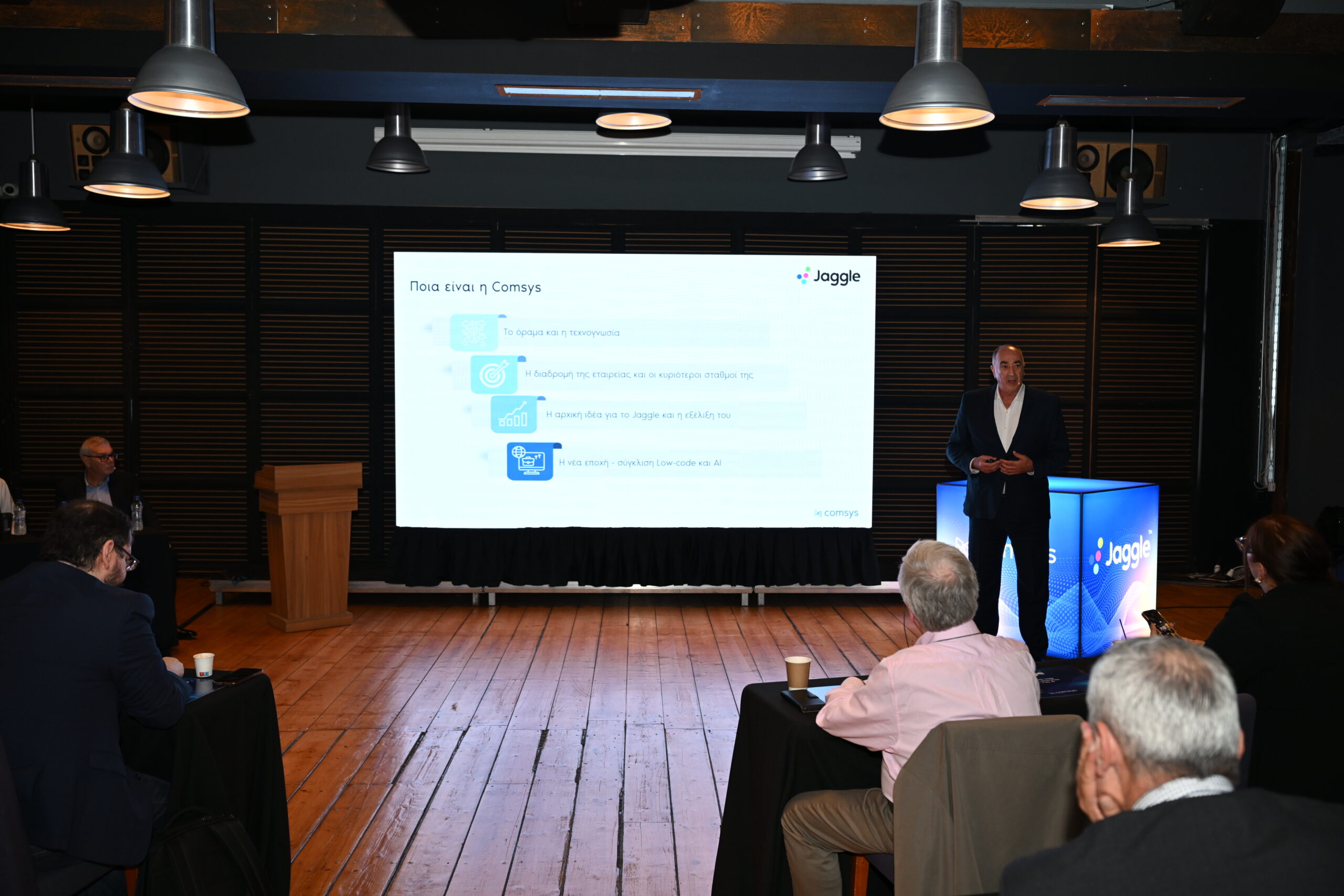
Στην έναρξη της εκδήλωσης, ο Βασίλης Γαλάκος, Executive President της Comsys, αναφέρθηκε στη διαδρομή και την τεχνογνωσία της εταιρείας, καθώς και στη στρατηγική επιλογή της δημιουργίας του Jaggle:
«Η Comsys, με εμπειρία άνω των 35 ετών σε έργα κρίσιμων επιχειρησιακών συστημάτων λογισμικού, αξιοποίησε τη γνώση και την τεχνολογική της ωριμότητα για να δημιουργήσει το Jaggle, μια πλατφόρμα που γεννήθηκε στην Ελλάδα και μπορεί να σταθεί ισότιμα με διεθνή προϊόντα. Σήμερα εκφράζουμε τη δέσμευσή μας για να συνεχίσουμε να επενδύουμε σε καινοτομία που έχει ουσία και αντίκρισμα για τις επιχειρήσεις.»
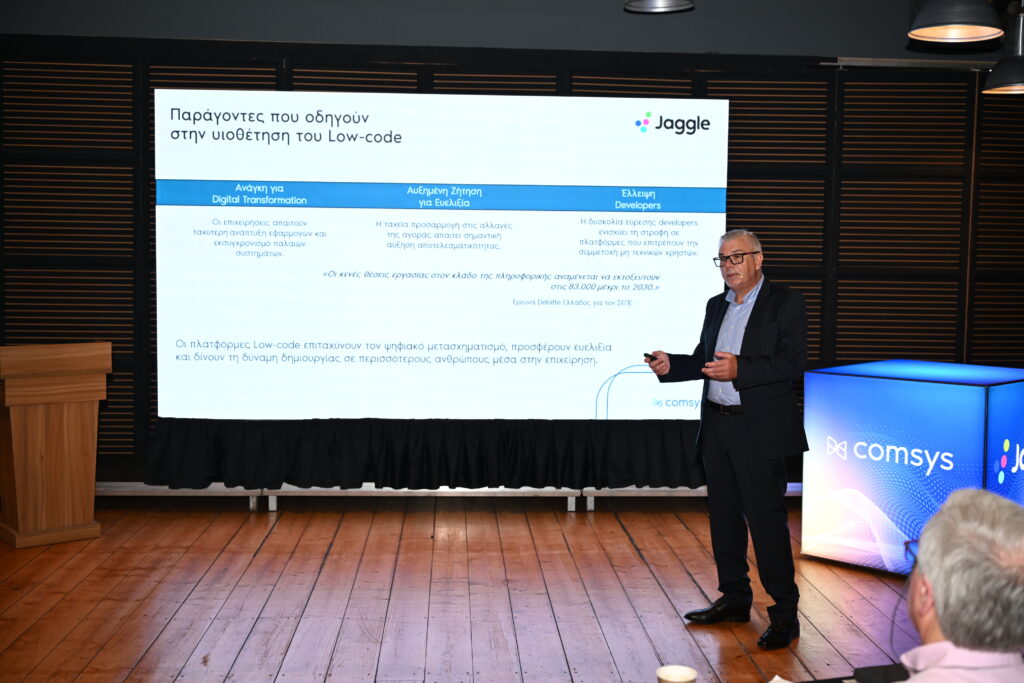
Ακολούθησε η ομιλία του Βαγγέλη Χατζηγεωργίου, Διευθύνοντος Συμβούλου της Comsys, ο οποίος τόνισε τη νέα στρατηγική κατεύθυνση της εταιρείας και τη σημασία του Jaggle στη μετάβαση προς μια νέα εποχή τεχνολογικής αυτονομίας:
«Το Jaggle δεν είναι απλώς μια νέα πλατφόρμα. Είναι το αποτέλεσμα μιας ευρύτερης στρατηγικής που συνδυάζει το Low-code με την τεχνητή νοημοσύνη, απελευθερώνοντας τις επιχειρήσεις από την πολυπλοκότητα και δίνοντάς τους τον έλεγχο της ανάπτυξης εφαρμογών. Πρόκειται για τεχνολογία ελληνικής παραγωγής, σχεδιασμένη με προοπτική διεθνούς ανάπτυξης και απόλυτη εστίαση στην αξιοπιστία και την ασφάλεια, δύο αρχές που χαρακτηρίζουν κάθε έργο της Comsys.»
Στη συνέχεια, ο Σπύρος Καραθανάσης, Chief Technology Officer της εταιρείας, παρουσίασε ζωντανά παραδείγματα των τεχνολογικών δυνατοτήτων του Jaggle, αναδεικνύοντας τη δύναμη της τεχνητής νοημοσύνης στη διαδικασία ανάπτυξης εφαρμογών:
«Με το Jaggle, η τεχνητή νοημοσύνη δεν λειτουργεί ως πρόσθετο εργαλείο, αλλά ως αναπόσπαστο στοιχείο της ίδιας της πλατφόρμας. Από τη μοντελοποίηση έως τη δημιουργία κώδικα και τεκμηρίωσης, το AI ενισχύει κάθε στάδιο, μειώνοντας τον χρόνο παράδοσης και αυξάνοντας τη συνοχή και την ακρίβεια των εφαρμογών.»
Το Jaggle σε δράση – Live Demo της πλατφόρμας
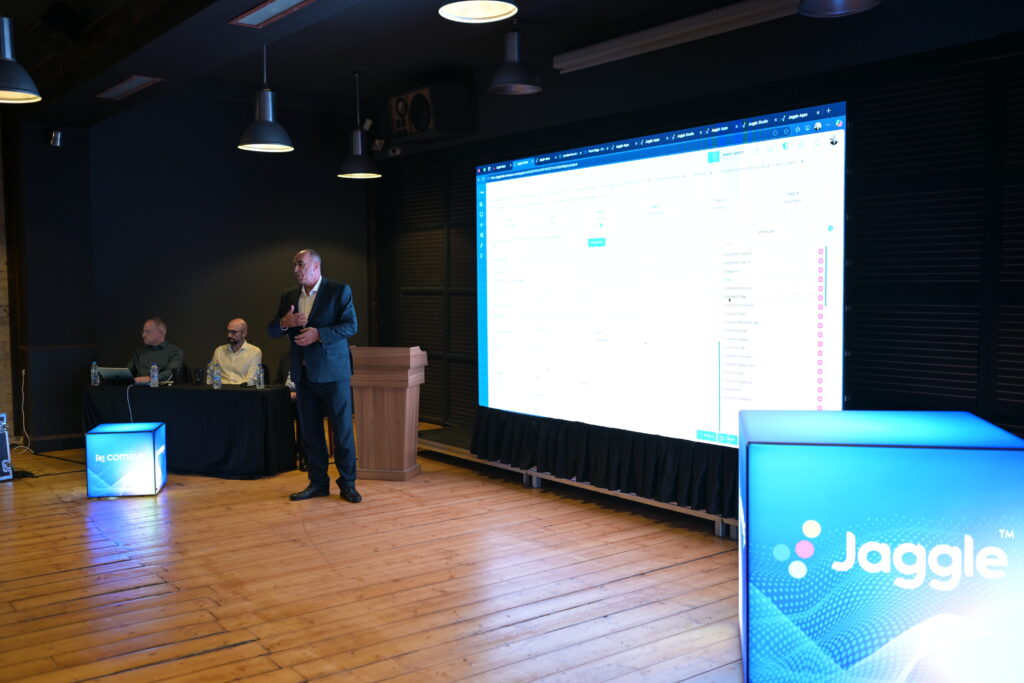
Κατά τη διάρκεια της ζωντανής παρουσίασης, οι Βασίλης Γαλάκος και Σπύρος Καραθανάσης παρουσίασαν πώς ένα πλήρες ticketing σύστημα για μεγάλο πελάτη του κλάδου ταχυμεταφορών που αναπτύχθηκε με το Jaggle, σε λιγότερο από το μισό του χρόνου που θα χρειαζόταν μια τέτοια εφαρμογή με τις παραδοσιακές μεθόδους ανάπτυξης.
Με τη χρήση Low-code και Generative AI, η εφαρμογή δημιουργήθηκε βήμα-βήμα: από τον σχεδιασμό της βάσης δεδομένων και των κανόνων ασφαλείας, έως τη δημιουργία του περιβάλλοντος χρήστη, των επιχειρησιακών ροών και των απαραίτητων διασυνδέσεων με άλλα συστήματα.
Οι συμμετέχοντες είδαν επίσης προηγμένες λειτουργίες όπως το Excel-like component, το Auto ML και κάποιες από τις άνω των 2.500 έτοιμων λειτουργιών που ενσωματώνονται αυτόματα στις εφαρμογές. Παράλληλα, παρουσιάστηκαν κρίσιμες δυνατότητες σε επίπεδο IT, Admin, Security, Auditing και Monitoring.
Η επίδειξη κορυφώθηκε με τις λειτουργίες του Jaggle που υποστηρίζονται από παραγωγική τεχνητή νοημοσύνη, από την αυτόματη δημιουργία των βάσεων δεδομένων και την μοντελοποίηση, ως την παραγωγή κώδικα, και την αυτό-τεκμηρίωση.
Το κοινό εντυπωσιάστηκε από την ταχύτητα και την ακρίβεια της πλατφόρμας, επιβεβαιώνοντας ότι το Jaggle επαναπροσδιορίζει στην πράξη τον τρόπο με τον οποίο οι επιχειρήσεις σχεδιάζουν και αναπτύσσουν εφαρμογές.
Case Studies και Demos
Κατά τη διάρκεια της παρουσίασης, πραγματοποιήθηκαν επίσης ζωντανές επιδείξεις από τα Jaggle.Conversational AI και Jaggle.RAG.
Οι συμμετέχοντες είχαν την ευκαιρία να δουν πώς το Jaggle συνδυάζει Low-code, AI και αυτοματοποίηση σε ένα ενιαίο οικοσύστημα, που προσφέρει στους οργανισμούς ευελιξία, ταχύτητα ανάπτυξης και έλεγχο στην ποιότητα των παραδοτέων.
Γιατί το Jaggle.eu ξεχωρίζει:
- Low-code πλατφόρμα για ταχύτατη ανάπτυξη ποιοτικών εφαρμογών.
- Ενσωματωμένες λειτουργίες τεχνητής νοημοσύνης, που υποβοηθούν την ανάπτυξη από το σχεδιασμό έως την τελικό ποιοτικό έλεγχο και την διαχείριση.
- Ασφάλεια και επεκτασιμότητα enterprise επιπέδου.
- Διαθεσιμότητα ως πλατφόρμα αλλά και ως υπηρεσία δημιουργίας εφαρμογών κατά παραγγελία από την Comsys.
Πληροφορίες για την εκδήλωση
Η εκδήλωση πραγματοποιήθηκε την Πέμπτη 6 Νοεμβρίου 2025, στο Gazarte, με τη συμμετοχή εκπροσώπων του Τύπου, συνεργατών της εταιρείας και στελεχών επιχειρήσεων από τον χώρο της τεχνολογίας.
Μετά την ολοκλήρωση των παρουσιάσεων, ακολούθησε Q&A session και δείπνο γνωριμίας, όπου οι παρευρισκόμενοι είχαν την ευκαιρία να συνομιλήσουν με τα στελέχη της εταιρείας και την ομάδα του Jaggle.eu.
Σχετικά με την Comsys
Η Comsys δραστηριοποιείται από το 1989 στην παροχή καινοτόμων λύσεων πληροφορικής και ολοκλήρωσης συστημάτων με έργα σε περισσότερες από 20 χώρες. Η εταιρεία επικεντρώνεται σε λύσεις Contact Center & Digital CX και Low-code Application Development, υποστηρίζοντας οργανισμούς στον ψηφιακό μετασχηματισμό τους.
Σχετικά με το Jaggle
Το Jaggle.eu είναι η ελληνική Low-code πλατφόρμα με ενσωματωμένη τεχνητή νοημοσύνη, που επιτρέπει στις επιχειρήσεις να σχεδιάζουν και να αναπτύσσουν εφαρμογές γρήγορα, με ασφάλεια και συνέπεια.
Η πλατφόρμα συνδυάζει προσέγγιση Low-code, AI automation και δυνατότητες ενοποίησης και διασύνδεσης, προσφέροντας στις ομάδες ανάπτυξης και στα επιχειρησιακά τμήματα ένα ενιαίο περιβάλλον συνεργασίας και καινοτομίας.
Για πληροφορίες αναφορικά με το Jaggle: [email protected]
Επικοινωνία για τα ΜΜΕ - [email protected] | www.jaggle.eu

October 22, 2025
Η Comsys ενισχύει τη διοικητική της ομάδα με τον Βαγγέλη Χατζηγεωργίου στη θέση του Διευθύνοντος Συμβούλου
Η αλλαγή ηγεσίας σηματοδοτεί τη συνέχιση της αναπτυξιακής πορείας της εταιρείας και την ενίσχυση της διοικητικής της ομάδας.
Η Comsys ανακοινώνει την ανάληψη της θέσης του Διευθύνοντος Συμβούλου από τον Βαγγέλη Χατζηγεωργίου, με άμεση ισχύ. Ο μέχρι σήμερα Διευθύνων Σύμβουλος, Βασίλης Γαλάκος, αναλαμβάνει ρόλο Εκτελεστικού Προέδρου. Η αλλαγή σηματοδοτεί την εξέλιξη της διοικητικής ομάδας της Comsys, στο πλαίσιο της στρατηγικής της ανάπτυξης στην ελληνική και διεθνή αγορά.
Ο Βαγγέλης Χατζηγεωργίου διαθέτει περισσότερα από 30 χρόνια εμπειρίας στον χώρο της πληροφορικής και του επιχειρηματικού λογισμικού, έχοντας διατελέσει σε ανώτατες διοικητικές θέσεις σε κορυφαίες εταιρείες του κλάδου. Πριν την ένταξή του στην Comsys, διετέλεσε Διευθύνων Σύμβουλος της SoftOne Impact, κορυφαίου παρόχου υπηρεσιών ηλεκτρονικής τιμολόγησης. Προηγουμένως, κατείχε τη θέση του Technology Director στην PwC. Για περισσότερα από 15 χρόνια διετέλεσε Γενικός Διευθυντής και μέλος του Διοικητικού Συμβουλίου του Ομίλου NetU, ενώ νωρίτερα είχε αναλάβει διευθυντικές θέσεις σε εταιρείες όπως οι Singular Software, Delta Singular και Baan. Είναι κάτοχος Μεταπτυχιακού Διπλώματος στη Διοίκηση Επιχειρήσεων (MBA) από το Πανεπιστήμιο του Sunderland και Πτυχίου Πληροφορικής (BSc Hons) από το Πανεπιστήμιο Northumbria του Newcastle.
Η ανάληψη της θέσης από τον Βαγγέλη Χατζηγεωργίου εντάσσεται στη στρατηγική της Comsys για ενίσχυση της διοικητικής της ομάδας και επιτάχυνση της αναπτυξιακής της πορείας στην Ελλάδα και το εξωτερικό. Η εταιρεία, με ιστορία άνω των τριών δεκαετιών, εστιάζει στην αξιοποίηση της τεχνογνωσίας της και στην καινοτόμο πλατφόρμα Jaggle.eu, την ελληνική πλατφόρμα low code που επιτρέπει την ταχεία ανάπτυξη εφαρμογών με ενσωματωμένες λειτουργίες τεχνητής νοημοσύνης. Στόχος της νέας διοικητικής σύνθεσης είναι η περαιτέρω ενδυνάμωση των στρατηγικών τομέων δραστηριότητας της Comsys και η ανάδειξή της ως ηγέτιδας δύναμης στον χώρο των επιχειρησιακών λύσεων νέας γενιάς.
Βαγγέλης Xατζηγεωργίου:
Με ιδιαίτερη χαρά και αίσθημα ευθύνης αναλαμβάνω τη θέση του Διευθύνοντος Συμβούλου της Comsys. Η εταιρεία έχει διαγράψει μια σταθερή και επιτυχημένη πορεία στον χώρο της τεχνολογίας και των ολοκληρωμένων επιχειρηματικών λύσεων, και είναι τιμή μου να συμβάλω στη συνέχιση και ενίσχυση αυτής της δυναμικής.
Στόχος μου είναι, σε συνεργασία με τη διοικητική ομάδα και όλους τους εργαζομένους, να ενισχύσουμε περαιτέρω την καινοτομία, την εξωστρέφεια και τη βιώσιμη ανάπτυξη της εταιρείας, αξιοποιώντας τις ευκαιρίες που προσφέρει η πλατφόρμα Jaggle.eu και που αναδεικνύει τη δέσμευση της Comsys στην ψηφιακή επιτάχυνση των επιχειρήσεων.
Θα ήθελα να εκφράσω τις θερμές μου ευχαριστίες προς τον Πρόεδρο, κ. Βασίλη Γαλάκο, για την εμπιστοσύνη και τη στήριξή του. Η καθοδήγησή του και το όραμά του για την Comsys αποτελούν ισχυρή βάση για τη μελλοντική μας πορεία.
Ανυπομονώ να συμβάλω με όλες μου τις δυνάμεις στο επόμενο κεφάλαιο ανάπτυξης της Comsys.
Βασίλης Γαλάκος:
Μετά από 36 χρόνια παρουσίας μου στην Comsys, είναι για μένα μεγάλη ικανοποίηση να βλέπω την εταιρεία να ενισχύει τη διοικητική της ομάδα με ένα έμπειρο και ικανό στέλεχος. Είμαι βέβαιος ότι με τον Βαγγέλη στο τιμόνι η Comsys θα συνεχίσει να αναπτύσσεται, να καινοτομεί και να δημιουργεί αξία για τους πελάτες και τους ανθρώπους της βασισμένη στις σταθερές της αξίες της συνέπειας και της αξιόπιστης συνεργασίας με τους φορείς της αγοράς.
Σχετικά με την Comsys
Η Comsys δραστηριοποιείται από το 1989 στην παροχή καινοτόμων λύσεων πληροφορικής και ολοκλήρωσης συστημάτων με έργα σε περισσότερες από 20 χώρες. Η εταιρεία επικεντρώνεται σε λύσεις Contact Center & Digital CX και Low-code Application Development, υποστηρίζοντας οργανισμούς στον ψηφιακό μετασχηματισμό τους.
Για πληροφορίες αναφορικά με το Jaggle: [email protected]
Επικοινωνία για τα ΜΜΕ: [email protected] | www.jaggle.eu

October 10, 2025
Η Comsys παρουσιάζει το Jaggle.eu στο Disrupt Lead AI Forum
Η Comsys συμμετέχει ως Gold Sponsor στο Disrupt Lead AI Forum 2025, την κορυφαία εκδήλωση για την Τεχνητή Νοημοσύνη και την Καινοτομία, όπου θα παρουσιάσει το Jaggle.eu, την ελληνική πλατφόρμα ταχείας ανάπτυξης επιχειρησιακών εφαρμογών (low-code application generation).
Η παρουσίαση θα πραγματοποιηθεί την Τετάρτη 15 Οκτωβρίου, στις 13:40, από τον Διευθύνοντα Σύμβουλο της Comsys, Βασίλη Γαλάκο, με τίτλο “Low-code Application Development in the Era of AI”, σε μια ομιλία που αναδεικνύει πώς η τεχνητή νοημοσύνη μετασχηματίζει τον τρόπο με τον οποίο οι οργανισμοί σχεδιάζουν και αναπτύσσουν επιχειρησιακές εφαρμογές.
Τι θα δουν οι επισκέπτες
Η παρουσίαση του Jaggle.eu θα επικεντρωθεί στη στην επιτάχυνση του κύκλου ανάπτυξης εφαρμογών με χρήση τεχνητής νοημοσύνης, μέσα από παραδείγματα πραγματικής χρήσης και παρουσίαση των ενσωματωμένων λειτουργιών που την αξιοποιούν.
Οι συμμετέχοντες θα δουν πώς το Jaggle.eu προσεγγίζει την μοντελοποίηση των εφαρμογών, την δημιουργία σύνθετου κώδικα, την δημιουργία τεκμηρίωσης σε πραγματικό χρόνο και την παραγωγή αναφορών και διαγραμμάτων δεδομένων με φυσικό λόγο, με αποτέλεσμα έως και 90% βελτίωση του χρόνου στην ανάπτυξη συστημάτων λογισμικού.
Η πλατφόρμα του Jaggle.eu εξασφαλίζει ισχυρή ασφάλεια, εύκολη επεκτασιμότητα και συμμόρφωση, για οργανισμούς που δραστηριοποιούνται σε πολύπλοκα ή ρυθμιζόμενα περιβάλλοντα.
«Με το Jaggle.eu φέρνουμε μια νέα εποχή στην ανάπτυξη επιχειρησιακού λογισμικού συνδυάζοντας ταχύτητα στην ανάπτυξη, μεγάλες δυνατότητες αυτοματοποίησης επιχειρησιακών διαδικασιών και ασφάλεια με τη δύναμη της τεχνητής νοημοσύνης. Οι δυνατότητες που παρουσιάζουμε στο Disrupt Lead AI Forum είναι παραγωγικά διαθέσιμες σήμερα, όχι μελλοντικές υποσχέσεις.»
Βασίλης Γαλάκος, CEO, Comsys
Σχετικά με το Jaggle
Το Jaggle.eu, η ελληνική πλατφόρμα low-code με ενσωματωμένη τεχνητή νοημοσύνη, είναι σχεδιασμένη για οργανισμούς που επιδιώκουν ταχύτητα ασφάλεια, και ευελιξία στον ψηφιακό τους μετασχηματισμό.
Βασισμένη στην μεθοδολογία low-code και με υποδομή enterprise-grade, η πλατφόρμα δίνει την δυνατότητα για δημιουργία εφαρμογών που είναι cloud-ready και διαθέτουν ενσωματωμένες σημαντικές λειτουργίες αυτοματοποίησης με την χρήση της τεχνητής νοημοσύνης. Το αποτέλεσμα είναι η μείωση του χρόνου ανάπτυξης έως και 90% με ταυτόχρονη βελτίωση της ποιότητας των εφαρμογών
Disrupt Lead AI Forum 2025 | 14–15 Οκτωβρίου 2025
Μουσείο Μπενάκη, Πειραιώς 138
Σχετικά με την Comsys
Η Comsys δραστηριοποιείται από το 1989 στην παροχή καινοτόμων λύσεων πληροφορικής και ολοκλήρωσης συστημάτων με έργα σε περισσότερες από 20 χώρες. Η εταιρεία επικεντρώνεται σε λύσεις Contact Center & Digital CX και Low-code Application Development, υποστηρίζοντας οργανισμούς στον ψηφιακό μετασχηματισμό τους.
Για πληροφορίες αναφορικά με το Jaggle: [email protected]