July 10, 2026
6 min read
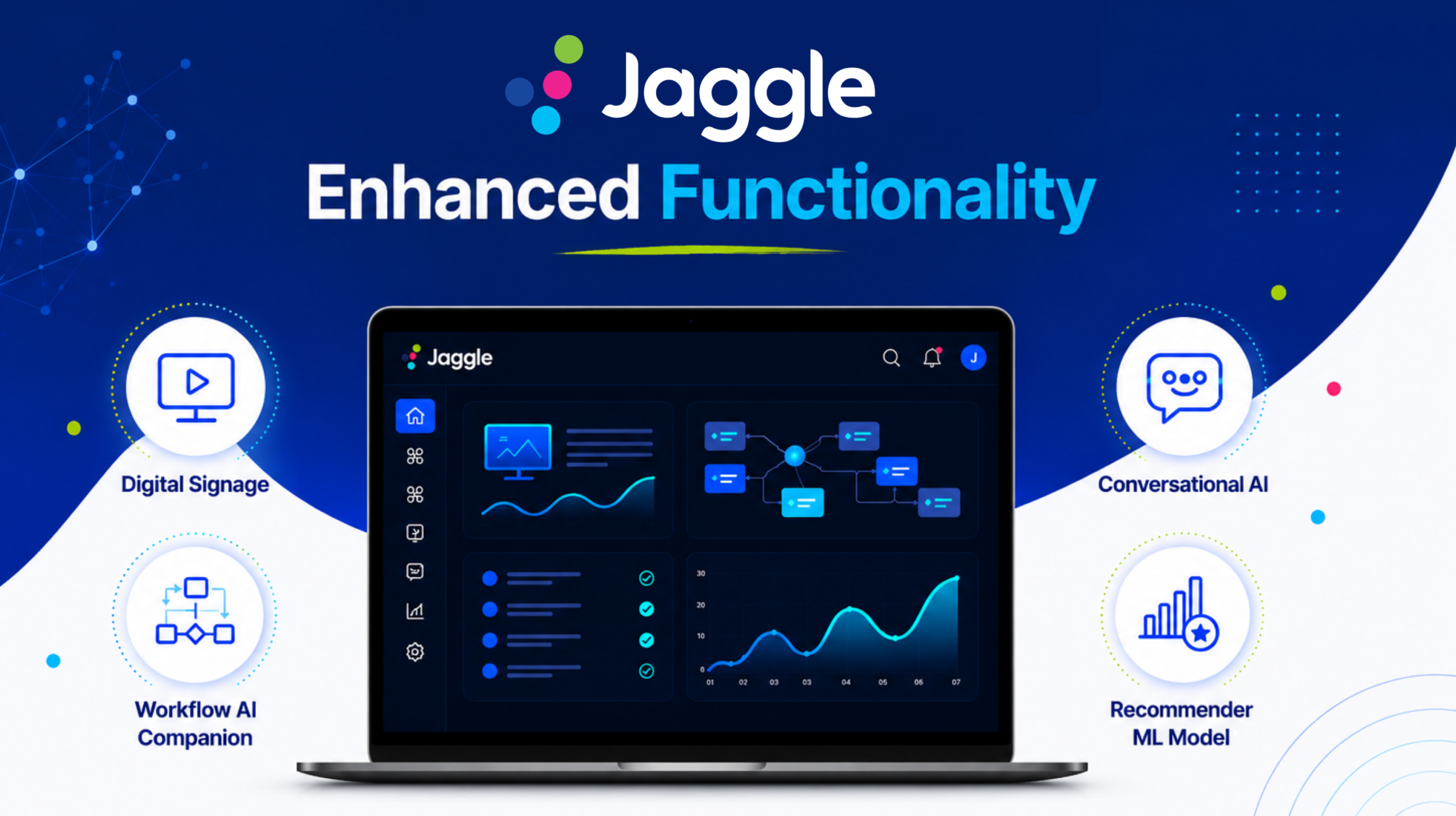
New Digital Signage App – One Platform, Every Screen
Jaggle now ships a native Digital Signage App that turns commercial displays and low-cost edge devices into fully managed, Jaggle-driven endpoints. It brings digital signage into the Jaggle platform as a first-class application – no proprietary media players, no separate CMS, no parallel toolchain. The same environment your teams already use to build pages, workflows, and conversational experiences now drives what appears on every screen in the building.
Runs natively where your screens already live
The app is built to run directly on the hardware organizations actually deploy: Samsung Tizen OS and LG webOS professional displays, and Raspberry Pi mini-PCs for everything else – from a single reception screen to a wall of departure boards. One app, one management model, across a mixed fleet. Registering a new screen is a matter of pointing the device at your Jaggle instance; from that moment it's a managed endpoint like any other.
Centrally authored, centrally controlled
Content, layouts, and playlists are authored and scheduled centrally in Jaggle and pushed to any screen or group of screens. Device grouping lets you target by location, department, or campaign; scheduling handles dayparting and time-boxed content; and remote monitoring reports playback status, device health, and connectivity so you know at a glance which screens are live and which need attention. Updates propagate over the air – there's no need to touch the hardware to change what's on it.
Resilient by design
Local caching keeps playback running through network interruptions. If a screen loses connectivity, it continues showing its scheduled content and re-syncs automatically once the connection returns – so a flaky branch network never leaves a display blank or frozen.
Live, data-driven content – not just slideshows
This is where the Digital Signage App separates itself from conventional signage tools. Because each screen is a Jaggle application, it can surface live, data-driven content straight from the same data model that powers the rest of the platform: queue counters and wait times, real-time KPIs and dashboards, branch-specific offers, wayfinding, and event information. Signage stops being a static loop of images and becomes a live window into your operational data.
Where it fits
Retail floors and store windows, banking and public-sector branch lobbies, transport hubs and departure halls, hospital and campus wayfinding, corporate lobbies and internal comms walls – anywhere a screen needs to show the right thing at the right time, driven by real data, managed from one place.
By folding signage into Jaggle, the app collapses the long-standing gap between "an app" and "a screen on the wall" into a single toolchain – one platform, every screen.
Jaggle Workflow AI Companion – Describe the Process, Get the Flow
Complementing the Page Development Helper on the UI side, the new Workflow AI Companion brings the same AI-assisted approach to business process design. Users describe a process in plain language – approvals, escalations, parallel branches, participants – and the Companion scaffolds the corresponding workflow, proposing steps, swim lanes, conditions, and actions that the designer can accept, refine, or extend.
Beyond first-draft generation, the Companion helps with the parts of complex workflows that usually slow teams down: suggesting decision logic, wiring in REST Web Service and Stored Procedure calls, recommending the right built-in actions (including Send Report), and flagging gaps or unreachable paths. What used to be an expert-only modelling exercise becomes an interactive, guided conversation – dramatically lowering the barrier to building sophisticated, production-grade processes.
Enhanced AI Page Builder – External REST APIs and Steering File
The AI Page Builder gets two significant upgrades that make its output both more capable and more consistent with each organization's standards: pages can now consume External REST APIs, and generation can be governed by a Steering File. Together they turn the builder from a fast scaffolder into a connected, standards-aware development partner.
External REST APIs
Until now, AI-generated pages worked primarily against the application's own Jaggle data model. With this release, the Page Builder can connect pages directly to external REST API endpoints – third-party services, partner systems, internal microservices, or any addressable API outside the current application.
Point the builder at an endpoint and it does the heavy lifting: it reads the request and response contract, maps fields to page components, and generates the controls, grids, and forms needed to display and interact with that data – already wired to the API. Parameters, headers, and authentication are configured once and reused, so a page that pulls live data from an external CRM, logistics tracker, pricing service, or open-data source can be stood up in minutes rather than hand-coded. Because the connection is a proper REST integration and not a static import, the page stays live: it reflects whatever the external service returns at runtime.
This closes a common gap in low-code tooling – the moment a page needs data that doesn't live in the platform, teams usually drop out to custom code. Now that same step is part of the guided, AI-assisted flow.
Steering File – generation that follows your rules
The second upgrade addresses consistency at scale. A new Steering File lets teams codify the conventions the AI must follow, and the builder reads it on every generation. Instead of producing generically "correct" output that then needs manual rework, the Page Builder produces pages that already match house style from the first draft.
A Steering File can capture preferred controls and component libraries, naming standards, layout and spacing conventions, data-binding patterns, accessibility requirements, and any organization-specific rules a lead developer would otherwise enforce in review. It acts as a single, reusable source of truth for "how we build pages here" – so a team of ten produces work that looks and behaves as if it came from one hand, and new contributors inherit the standards automatically.
Better together
The two features reinforce each other. External REST API connectivity widens what the builder can reach; the Steering File governs how it builds against it. A page that consumes a partner API arrives not only wired and functional, but already conformant to your controls, naming, and accessibility rules – ready for review rather than rework.
New Recommender ML Model – Built-In Personalization
Building on the AutoML engine introduced in 2026.1, Jaggle adds a dedicated recommender model for recommendation and next-best-action scenarios. Teams can now train and deploy recommendations directly inside the platform – product and content suggestions, cross-sell and up-sell, next-best-offer, and personalized routing – without stitching together an external ML stack.
The model supports collaborative and content-based approaches, learns from the application's own data model, and exposes recommendations to any Jaggle page, workflow, or conversational dialogue through the same AI layer as the rest of the platform. For retail, banking, telecom, and media use cases, it puts personalization within reach of business teams, not just data-science specialists.
New Digital Signage App – One Platform, Every Screen
Jaggle now ships a native Digital Signage App that turns commercial displays and low-cost edge devices into fully managed, Jaggle-driven endpoints. It brings digital signage into the Jaggle platform as a first-class application – no proprietary media players, no separate CMS, no parallel toolchain. The same environment your teams already use to build pages, workflows, and conversational experiences now drives what appears on every screen in the building.
Runs natively where your screens already live
The app is built to run directly on the hardware organizations actually deploy: Samsung Tizen OS and LG webOS professional displays, and Raspberry Pi mini-PCs for everything else – from a single reception screen to a wall of departure boards. One app, one management model, across a mixed fleet. Registering a new screen is a matter of pointing the device at your Jaggle instance; from that moment it’s a managed endpoint like any other.
Centrally authored, centrally controlled
Content, layouts, and playlists are authored and scheduled centrally in Jaggle and pushed to any screen or group of screens. Device grouping lets you target by location, department, or campaign; scheduling handles dayparting and time-boxed content; and remote monitoring reports playback status, device health, and connectivity so you know at a glance which screens are live and which need attention. Updates propagate over the air – there’s no need to touch the hardware to change what’s on it.
Resilient by design
Local caching keeps playback running through network interruptions. If a screen loses connectivity, it continues showing its scheduled content and re-syncs automatically once the connection returns – so a flaky branch network never leaves a display blank or frozen.
Live, data-driven content – not just slideshows
This is where the Digital Signage App separates itself from conventional signage tools. Because each screen is a Jaggle application, it can surface live, data-driven content straight from the same data model that powers the rest of the platform: queue counters and wait times, real-time KPIs and dashboards, branch-specific offers, wayfinding, and event information. Signage stops being a static loop of images and becomes a live window into your operational data.
Where it fits
Retail floors and store windows, banking and public-sector branch lobbies, transport hubs and departure halls, hospital and campus wayfinding, corporate lobbies and internal comms walls – anywhere a screen needs to show the right thing at the right time, driven by real data, managed from one place.
By folding signage into Jaggle, the app collapses the long-standing gap between “an app” and “a screen on the wall” into a single toolchain – one platform, every screen.
Jaggle Workflow AI Companion – Describe the Process, Get the Flow
Complementing the Page Development Helper on the UI side, the new Workflow AI Companion brings the same AI-assisted approach to business process design. Users describe a process in plain language – approvals, escalations, parallel branches, participants – and the Companion scaffolds the corresponding workflow, proposing steps, swim lanes, conditions, and actions that the designer can accept, refine, or extend.
Beyond first-draft generation, the Companion helps with the parts of complex workflows that usually slow teams down: suggesting decision logic, wiring in REST Web Service and Stored Procedure calls, recommending the right built-in actions (including Send Report), and flagging gaps or unreachable paths. What used to be an expert-only modelling exercise becomes an interactive, guided conversation – dramatically lowering the barrier to building sophisticated, production-grade processes.
Enhanced AI Page Builder – External REST APIs and Steering File
The AI Page Builder gets two significant upgrades that make its output both more capable and more consistent with each organization’s standards: pages can now consume External REST APIs, and generation can be governed by a Steering File. Together they turn the builder from a fast scaffolder into a connected, standards-aware development partner.
External REST APIs
Until now, AI-generated pages worked primarily against the application’s own Jaggle data model. With this release, the Page Builder can connect pages directly to external REST API endpoints – third-party services, partner systems, internal microservices, or any addressable API outside the current application.
Point the builder at an endpoint and it does the heavy lifting: it reads the request and response contract, maps fields to page components, and generates the controls, grids, and forms needed to display and interact with that data – already wired to the API. Parameters, headers, and authentication are configured once and reused, so a page that pulls live data from an external CRM, logistics tracker, pricing service, or open-data source can be stood up in minutes rather than hand-coded. Because the connection is a proper REST integration and not a static import, the page stays live: it reflects whatever the external service returns at runtime.
This closes a common gap in low-code tooling – the moment a page needs data that doesn’t live in the platform, teams usually drop out to custom code. Now that same step is part of the guided, AI-assisted flow.
Steering File – generation that follows your rules
The second upgrade addresses consistency at scale. A new Steering File lets teams codify the conventions the AI must follow, and the builder reads it on every generation. Instead of producing generically “correct” output that then needs manual rework, the Page Builder produces pages that already match house style from the first draft.
A Steering File can capture preferred controls and component libraries, naming standards, layout and spacing conventions, data-binding patterns, accessibility requirements, and any organization-specific rules a lead developer would otherwise enforce in review. It acts as a single, reusable source of truth for “how we build pages here” – so a team of ten produces work that looks and behaves as if it came from one hand, and new contributors inherit the standards automatically.
Better together
The two features reinforce each other. External REST API connectivity widens what the builder can reach; the Steering File governs how it builds against it. A page that consumes a partner API arrives not only wired and functional, but already conformant to your controls, naming, and accessibility rules – ready for review rather than rework.
New Recommender ML Model – Built-In Personalization
Building on the AutoML engine introduced in 2026.1, Jaggle adds a dedicated recommender model for recommendation and next-best-action scenarios. Teams can now train and deploy recommendations directly inside the platform – product and content suggestions, cross-sell and up-sell, next-best-offer, and personalized routing – without stitching together an external ML stack.
The model supports collaborative and content-based approaches, learns from the application’s own data model, and exposes recommendations to any Jaggle page, workflow, or conversational dialogue through the same AI layer as the rest of the platform. For retail, banking, telecom, and media use cases, it puts personalization within reach of business teams, not just data-science specialists.

